
Every sustainment staff produces the same artifact every day: one page for the commander. What is short, where, when it runs out, what we recommend. It takes a planner an hour or two to roll up, and by the time it is briefed the numbers are already old. We built the decision brief into the ALLCLASS demonstration so the page writes itself from the same numbers as every other screen, and so every line on it can be traced back to where it came from.
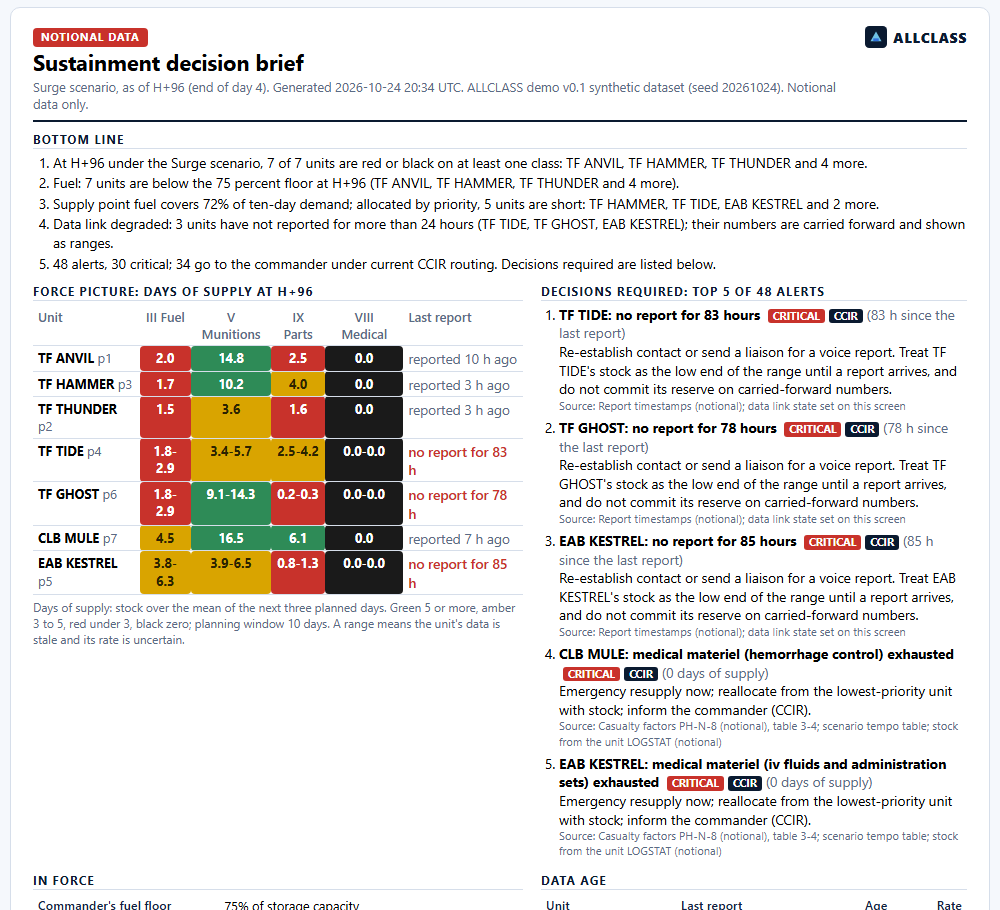
What is on the page
- Bottom line first. Five sentences, computed: how many units are red or black on any class of supply, who is below the fuel floor now and who breaches it inside the window, whether the supply point covers demand and who is short, how many units have stopped reporting, and how many alerts go to the commander under current routing.
- The force picture. Days of supply for every unit across fuel, munitions, repair parts, and medical materiel, with the age of each unit's last report. A unit that has gone quiet shows a range instead of a number, because its rate of use is no longer known.
- The decisions required. The top five alerts, each with why it fired, the number behind it, the recommended action, and the source of the number.
- What is in force. The commander's floor, the supply available against demand, how the shortfall was allocated, the pushes still to arrive, the state of the data link.
- Data age. Which units have not reported, since when, and how much uncertainty that puts on their numbers.
It prints to one page from the browser, copies as plain text into a message, and carries a link that reopens the same brief for the same time, scenario, and data link state.
Why the sources matter more than the layout
A staff officer who hands the commander a number is accountable for it. That is why every number in the demonstration opens a card with the formula, the inputs and where each one came from, the function that computed it and what it does not model. The brief inherits that. When the commander asks where the day-two breach came from, the answer is on the page: the unit's reported stock, its equipment list and planned tempo, the planning factor table, and the scheduled pushes in the order.
The same discipline applies when the data stops. A degraded or denied data link does not make the picture go blank. The last report is carried forward, the uncertainty widens by the day, the cells show a range, and an alert puts the silent unit on the commander's list. The brief says so in its bottom line. A picture that pretends to know is worse than one that says how old its numbers are.
What the demonstration is, and is not
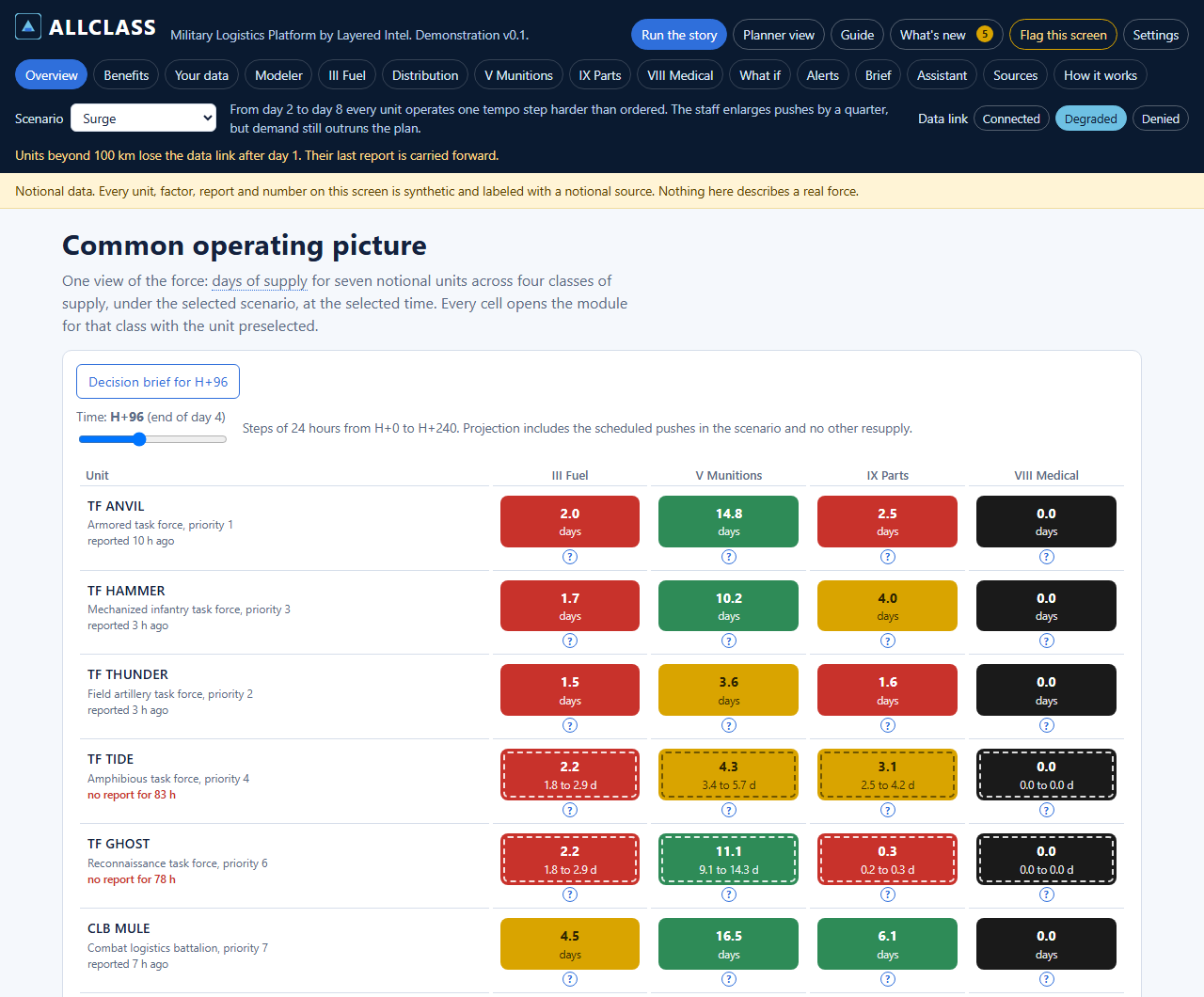
ALLCLASS is a bolt-on logistics intelligence platform for supply Classes I through IX, built to sit beside the systems of record a force already runs. The demonstration runs at allclass.layeredintel.com for invited reviewers, entirely in the browser on synthetic data: seven notional units, three scenarios, a data link that can be degraded or denied, and a guided walkthrough that runs the story in sixteen steps. It now includes a distribution module with a finite fleet and route threat, a what-if screen for fuel, munitions, and repair parts, and a mixed-integer solver that plans every dispatch day at once beside the day-by-day rule, so a planner can read both and choose.
It is not a fielded system, and it does not claim to be. Production replaces the browser solver with a server-side one behind the same inputs and outputs, reads real systems of record through published data contracts, and is proved on a pilot with a staff's own data: the staff's plan and ALLCLASS, side by side, scored on forecast accuracy, resupply footprint, stockouts, and time to plan.
Who it is for
Joint and Service planning staffs, combatant command logistics directorates, wargaming centers, and the program offices responsible for sustainment planning. Layered Intel is a nontraditional defense contractor, which opens the prototype Other Transaction and Commercial Solutions Opening paths for a command that wants to shape the platform against its own problem set.
Every screen in the demonstration is synthetic and labeled with a notional source. No real unit, location, or person appears anywhere in it.